





Build vs Buy: When Custom Software Actually Makes Sense for Startups
-
By Qubeta Technolab
- Aug 24, 2026

Read our latest insights on Build vs Buy: When Custom Software Actually Makes Sense for Startups from Qubeta Technolab covering technology, software development, digital marketing and business growth.
Every startup eventually hits the same fork in the road: keep stitching together off-the-shelf tools, or invest in custom software built specifically for how the business actually works. Get this decision wrong in either direction, and it's expensive — either you burn months and lakhs building something a Rs. 2,000/month tool already does well, or you keep bolting together five different SaaS platforms until the whole system collapses under its own complexity.
There's no universal right answer here. But there is a clear, practical way to think through it — and that's what most "build vs buy" advice skips over.
Why "Buy" Is Usually the Right Starting Point
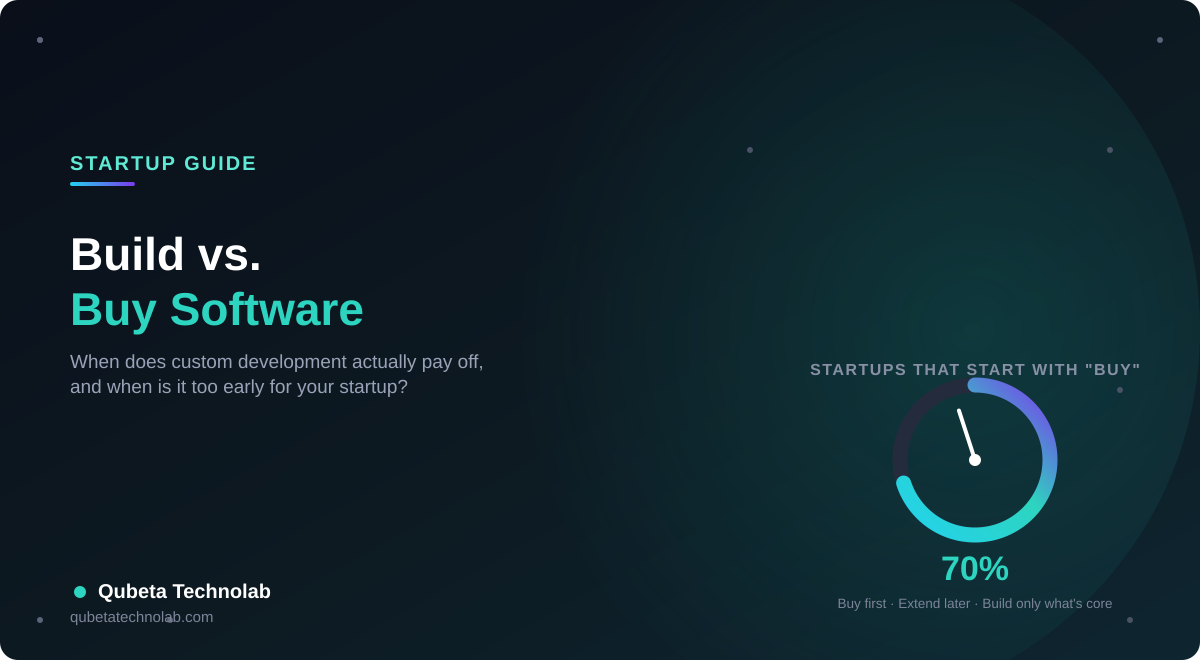
For almost every early-stage startup, the smart default is to buy off-the-shelf software first. Here's why:
Speed to market matters more than perfection early on. A startup's first job is proving the business model works — not building infrastructure. Off-the-shelf CRM, accounting, HR, or project management tools can be set up in days, not months.
You don't yet know your exact requirements. In the first year or two, most startups are still figuring out their actual workflows. Building custom software around processes that are still changing every quarter is a recipe for wasted development time.
Off-the-shelf tools are cheaper upfront. A subscription costs a fraction of what custom development costs, and comes with ongoing updates, security patches, and support already built in.
You avoid becoming a software company by accident. The moment you build custom software, you also take on the responsibility of maintaining it — bug fixes, updates, hosting, security. That's a real, ongoing cost most early startups aren't ready to carry.
This is why almost every successful startup starts on generic SaaS tools: Gmail, a CRM like HubSpot or Zoho, Slack, spreadsheets, maybe a no-code tool for internal workflows. This isn't a compromise — it's the right call at that stage.
The Signs You've Outgrown "Buy"
The shift toward custom software usually isn't a single decision — it's a slow accumulation of friction that eventually becomes too costly to ignore. Watch for these signs:
You're paying for five tools that don't talk to each other When your team spends real time manually copying data between your CRM, your inventory system, and your invoicing tool, the "cheap" software stack is quietly costing you in hours, errors, and missed follow-ups.
You're bending your business to fit the software, not the other way around If your team has built workarounds, spreadsheets-on-the-side, or manual double-entry just to make an off-the-shelf tool fit your actual process, that's a sign the tool is now working against you.
The software can't scale with your volume or complexity Many tools that work fine at 50 customers start breaking down at 5,000 — hitting rate limits, becoming painfully slow, or simply not supporting the scale of your operations anymore.
Your workflow is now your competitive advantage If the way you do something — a unique pricing model, a proprietary matching algorithm, a specific customer experience — is actually part of what makes your startup different, forcing it into a generic tool limits your ability to differentiate.
You're paying more for customization than you would for custom-built software Some SaaS platforms charge steep fees for "enterprise" tiers just to unlock the features you actually need. At a certain point, that ongoing cost can exceed what a one-time custom build would have cost.
Security or compliance requirements outgrow what generic tools offer If you're handling sensitive financial, health, or regulated data at scale, off-the-shelf tools may not meet the specific compliance or data-residency requirements your business now needs.
A Practical Framework: Ask These Questions First
Before deciding to build, it's worth running through a short checklist:
- Is this a core differentiator, or a commodity function? Build for what makes you unique (your core product, your unique workflow). Buy for what every business needs (accounting, email, basic CRM).
- How much is the current inefficiency actually costing you — in hours, in errors, in lost customers — versus what a custom build would cost?
- Will your requirements stay stable enough to justify building, or are you still likely to pivot in the next 6–12 months?
- Do you have (or can you access) the technical capacity to maintain custom software long-term, not just build it once?
- Is there a middle ground — customizing or extending an existing platform via APIs and plugins, instead of building entirely from scratch?
That last point matters more than most founders realize. Build vs buy isn't always binary.
The Middle Path: Extend, Don't Always Replace
A lot of startups assume "build" means starting from zero. In practice, one of the most cost-effective approaches is building custom integrations and extensions on top of existing platforms — keeping the parts of your stack that work well (accounting, payments, email) while custom-building only the piece that's genuinely unique to your business.
This hybrid approach gets you:
- Lower cost than a full custom build
- Faster time to market than building everything from scratch
- The flexibility to differentiate exactly where it matters
- Less long-term maintenance burden than owning your entire stack
For many growing startups, this middle path — not a full rebuild — is where real value ends up living.
What Custom Software Actually Costs (Beyond the Build)
Founders often underestimate that the initial build is only part of the cost. A realistic view of custom software includes:
- Development time and cost — the visible, upfront investment
- Ongoing maintenance — bug fixes, security patches, feature updates
- Hosting and infrastructure — servers, backups, uptime monitoring
- Support — someone needs to help your team when something breaks
- Opportunity cost — the time your team spends managing software instead of the core business
None of this means custom software isn't worth it — for the right use case, it clearly is. It just means the decision should be made with the full cost in view, not just the initial development quote.
How Qubeta Technolab Approaches This With Startups
We don't default to recommending a full custom build, even though that's often the more profitable engagement for a development company. Instead, we start by understanding what's actually causing friction in your current setup — and in a lot of cases, the right answer is a targeted custom integration or extension, not a ground-up rebuild.
When custom software genuinely is the right call — because your workflow is your differentiator, or you've outgrown what generic tools can offer — we build it to scale with you from day one, not just solve today's problem.
As a software development company in Ahmedabad, Qubeta Technolab has worked with startups across Gujarat and India at exactly this fork in the road — helping them figure out whether to buy, build, or do both, before committing budget in the wrong direction.
Not sure whether your startup should build or buy? Contact Qubeta Technolab today for a free consultation, and we'll help you map out the most cost-effective path forward.
Explore More
Request A Call Back
Ever find yourself stuck trying to articulate your IT needs or find the right tech solutions for your business? We're here to simplify the process. Let our experts guide you toward innovative, tailored IT solutions that drive success.
