






Retargeting Ads Explained: Turning Website Visitors Into Paying Customers
-
By Qubeta Technolab
- Sep 21, 2026

Read our latest insights on Retargeting Ads Explained: Turning Website Visitors Into Paying Customers from Qubeta Technolab covering technology, software development, digital marketing and business growth.
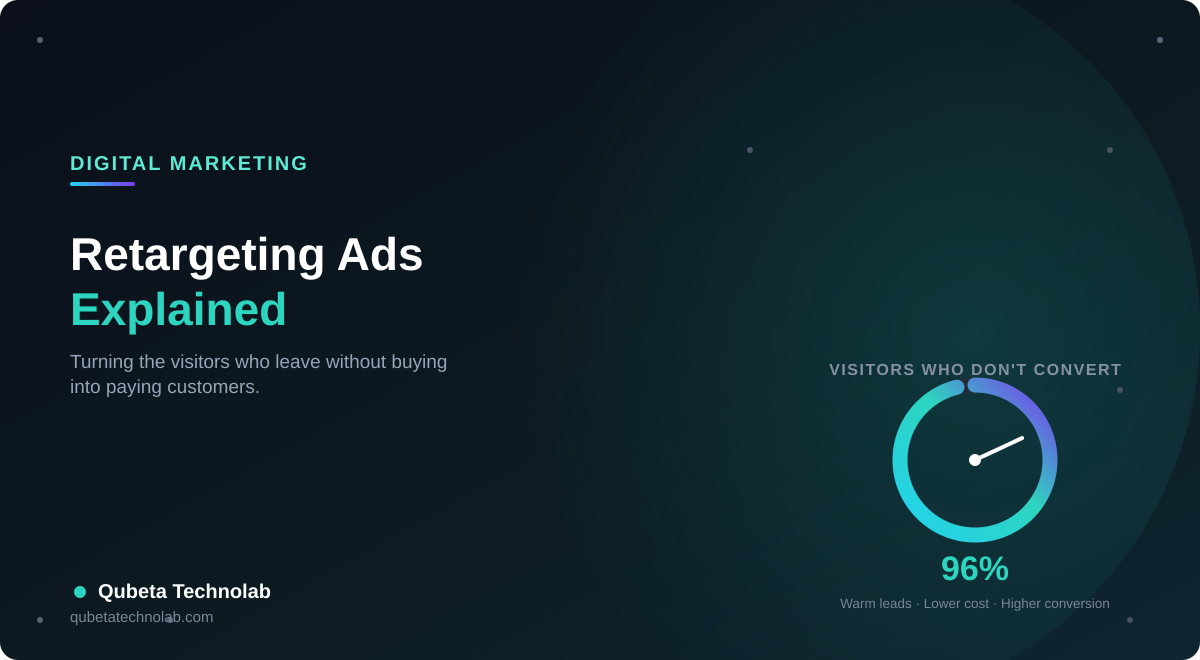
Here's a number that surprises most business owners the first time they hear it: on average, only about 2-4% of website visitors convert on their first visit. The other 96-98% leave without buying, booking, or signing up — not necessarily because they weren't interested, but because they weren't ready yet, got distracted, or wanted to compare options first.
Most businesses treat those visitors as a lost cause. That's exactly where retargeting ads come in — and why they consistently deliver some of the highest returns of any paid advertising strategy.
What Retargeting Actually Is
Retargeting (sometimes called remarketing) is a form of online advertising that shows ads specifically to people who have already interacted with your business — visited your website, viewed a product, added something to their cart, or engaged with your app — but didn't convert.
Here's how it works in simple terms: when someone visits your website, a small piece of code (a pixel, from platforms like Meta, Google, or LinkedIn) quietly notes that visit. Later, as that person browses other sites, checks social media, or watches YouTube, your ads start appearing to them — reminding them about the product they viewed, the cart they abandoned, or the service they were considering.
Unlike cold advertising, which is trying to capture the attention of people who've never heard of you, retargeting reaches people who already know your brand — which is exactly why it converts so much better.
Why Retargeting Outperforms Regular Ads
You're advertising to warm leads, not strangers A person who's already visited your pricing page or viewed a product is dramatically more likely to convert than someone seeing your brand for the first time. Retargeting focuses your ad budget on the audience most likely to actually buy.
It closes the gap between interest and action Many people genuinely intend to come back and buy, but get distracted, forget, or want to think it over. Retargeting keeps your business visible during that decision window instead of letting the moment pass silently.
It costs less per conversion Because retargeting audiences are smaller and more qualified than broad cold audiences, cost-per-click and cost-per-conversion are typically lower — meaning your ad spend works harder.
It reinforces brand recall Even for visitors who don't convert immediately, repeated, relevant exposure keeps your business top-of-mind, so when they are ready to buy, you're the name they remember.
The Most Effective Types of Retargeting
Website Retargeting
The most common form — targeting anyone who visited your site, or specific pages (like a product page or pricing page), with ads relevant to what they looked at.
Cart Abandonment Retargeting
For e-commerce businesses, this is often the single highest-converting retargeting segment. Someone added a product to their cart and left — a well-timed ad (sometimes paired with a small incentive) can recover a meaningful share of those lost sales.
Customer List Retargeting
Uploading your existing customer or lead list to platforms like Meta or Google lets you target past customers with upsells, renewals, or win-back offers — or exclude them entirely from acquisition campaigns to avoid wasted spend.
Video & Engagement Retargeting
On platforms like YouTube or Instagram, you can retarget people who watched a certain percentage of your video content or engaged with a post — useful for businesses building awareness before a direct sales push.
Search Retargeting
Rather than relying only on your own website visitors, this targets people who searched for relevant keywords elsewhere, expanding your retargeting pool beyond just past visitors.
Building a Retargeting Campaign That Actually Converts
Segment your audience — don't treat every visitor the same Someone who viewed your homepage for ten seconds is very different from someone who added a product to their cart. Effective retargeting separates these groups and shows each one a different message.
Match the ad to the visitor's intent A cart-abandonment ad should look different from a first-time-visitor ad. The closer someone got to converting, the more direct your ad can be — sometimes even referencing the specific product they viewed.
Set frequency caps Showing the same ad to the same person 20 times a day doesn't increase conversions — it creates ad fatigue and can actively damage brand perception. Capping how often someone sees your retargeting ads keeps the strategy effective instead of annoying.
Use time-based windows Someone who visited 90 days ago and never returned is a very different prospect than someone who visited yesterday. Structuring campaigns around 7-day, 30-day, and 90-day windows lets you adjust messaging and urgency accordingly.
Consider a small incentive for high-value segments For cart abandoners or highly engaged visitors close to converting, a modest, well-placed offer (free shipping, a small discount, a limited-time bonus) can be the final nudge — without needing to discount broadly across your whole audience.
Common Mistakes That Waste Retargeting Budget
- Retargeting everyone the same way, regardless of how far they got in your funnel
- No frequency cap, leading to ad fatigue and wasted impressions
- Forgetting to exclude converters, so people who already bought keep seeing ads for the same product
- Static, generic ads that don't reference what the person actually looked at
- No clear landing page match — sending someone back to your homepage instead of the exact product or page they were interested in
Where This Fits Into a Bigger Marketing Picture
Retargeting isn't a replacement for getting new visitors to your site in the first place — it's what makes the traffic you're already paying for (through SEO, social media, or other ads) actually worth more. Businesses that combine solid traffic generation with disciplined retargeting consistently get more value out of the same overall marketing spend, because fewer visitors are wasted after that first visit.
The Bottom Line
Most of your website's traffic isn't converting on the first visit — and that's normal, not a failure. What separates businesses that grow efficiently from those that don't is whether they have a system in place to bring those visitors back. Retargeting ads are that system — reaching people who already showed interest, at a lower cost than acquiring a stranger, with a message tailored to exactly where they left off.
As a digital marketing company in Ahmedabad, Qubeta Technolab helps businesses across Gujarat and India set up retargeting campaigns that are properly segmented, well-timed, and built around real visitor behavior — not a one-size-fits-all ad blast.
Ready to stop losing visitors after their first visit? Contact Qubeta Technolab today for a free consultation on setting up retargeting campaigns that actually convert.
Explore More
Request A Call Back
Ever find yourself stuck trying to articulate your IT needs or find the right tech solutions for your business? We're here to simplify the process. Let our experts guide you toward innovative, tailored IT solutions that drive success.
