






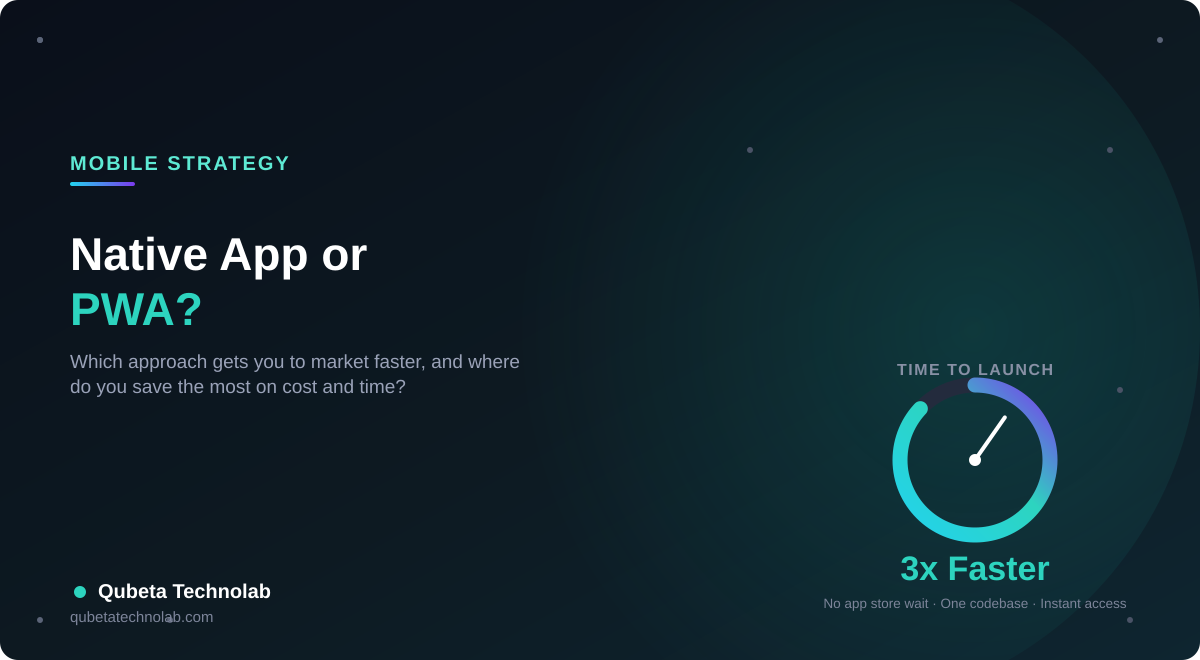
Should Your Business Build a Mobile App or a Progressive Web App (PWA)?
-
By Qubeta Technolab
- Aug 20, 2026

Read our latest insights on Should Your Business Build a Mobile App or a Progressive Web App (PWA)? from Qubeta Technolab covering technology, software development, digital marketing and business growth.
At some point, almost every growing business asks the same question: "Do we need a mobile app?" It seems like a simple decision, but it usually isn't — because "mobile app" today actually means two very different things: a native mobile app you download from the App Store or Play Store, or a Progressive Web App (PWA) that lives in the browser but behaves like an app.
Both can put your business on a customer's home screen. Both can send push notifications and work offline. But they're built differently, cost differently, and suit different kinds of businesses. Getting this choice right upfront can save months of development time and a significant chunk of your budget.
What's the Actual Difference?
A native mobile app is built specifically for iOS or Android (often both, as separate builds), submitted to app stores, and installed directly on a user's device. It has full access to device hardware — camera, GPS, Bluetooth, biometric sensors — and generally delivers the smoothest, fastest experience possible.
A Progressive Web App (PWA) is essentially a website built to behave like an app. Users can "install" it to their home screen directly from the browser — no app store required. It can work offline, send push notifications, and load fast, but it's still fundamentally a web app running through browser technology, which means it has more limited access to native device features.
Where Native Apps Win
Performance-heavy or hardware-dependent use cases If your app needs deep camera integration, offline-first functionality with large local data, background location tracking, or Bluetooth device pairing, native is usually the only real option. Native apps are compiled specifically for the device's operating system, so they run faster and more reliably for demanding tasks.
App store visibility Being discoverable in the App Store or Play Store matters for certain business models — consumer apps that rely on organic discovery, ratings, and reviews benefit from being where users are already searching.
Brand and user trust For some industries — especially finance, healthcare, or anything handling sensitive data — users simply trust an app-store-listed app more than a browser-based one, regardless of the actual technical difference.
Rich, complex user interactions Apps with heavy animation, gaming elements, or highly customized UI components tend to feel noticeably smoother as native apps.
Where PWAs Win
Speed to market and budget A PWA is typically a single codebase that works across devices and platforms — no separate iOS and Android builds, no app store review process. For businesses that need to launch fast and validate an idea before committing to a bigger build, this is a major advantage.
No app store friction Users can start using a PWA instantly by visiting a link — no download, no install screen, no waiting on app store approval. This lowers the barrier for first-time users significantly, which matters a lot for e-commerce, service booking, or content-driven businesses.
Lower maintenance cost Since there's one codebase instead of two (or three, counting a web version), updates roll out instantly to every user without needing app store re-approval. This keeps ongoing development and maintenance costs meaningfully lower.
SEO and discoverability Unlike native apps, PWAs are indexable by search engines. That means your app content can actually show up in Google search results — something a native app locked inside an app store simply cannot do.
A Simple Way to Decide
Ask yourself these questions:
- Does your app need deep hardware access (camera, GPS tracking in the background, Bluetooth, biometrics)? → Lean native.
- Is speed to launch and budget your biggest constraint right now? → Lean PWA.
- Does your business depend on app store discovery for growth (consumer apps, gaming, subscription apps)? → Lean native.
- Do most of your users find you through search or social media, not app stores? → Lean PWA.
- Will your app be used constantly, for long sessions, with complex interactions (like a banking or productivity app)? → Lean native.
- Is your primary goal to convert website visitors into repeat users at low cost (bookings, e-commerce, content)? → Lean PWA.
For many businesses, especially those just starting to invest in mobile, a PWA is the more practical first step — it validates demand and delivers real value quickly, without the cost of building and maintaining two separate native apps.
The Hybrid Approach Many Businesses Miss
It's not always an either/or decision. A common, cost-effective strategy is to launch as a PWA first, gather real usage data, and then invest in a native app once you've confirmed which features actually matter to your users — instead of guessing upfront and over-building.
This phased approach avoids one of the most expensive mistakes businesses make: spending months building a fully native app with features nobody ends up using.
What This Looks Like in Practice
- A restaurant or service business taking online orders and bookings → PWA is usually more than enough, and gets customers ordering in seconds without an app store detour.
- A logistics or field-service company needing offline maps, camera scanning, and background GPS tracking → native is the safer investment.
- A retail or e-commerce brand wanting broad reach with lower cost → PWA first, native later if growth justifies it.
- A fintech or healthcare platform handling sensitive data and biometric login → native is typically expected and often required for compliance.
There's no universally "better" option between a native app and a PWA — only what's better for your specific business, budget, and users. The right question isn't "which is more advanced," it's "which one actually solves the problem our customers have right now, without over-investing before we know it'll pay off."
As an IT solutions company in Ahmedabad, Qubeta Technolab has built both native mobile apps and Progressive Web Apps for businesses across Ahmedabad, Gujarat, and beyond — and we always start with your actual use case, not a default answer. Sometimes that means a PWA gets you to market in weeks. Sometimes it means native is the only way to deliver what your users truly need.
Not sure which fits your business? Contact Qubeta Technolab today for a free consultation, and we'll help you figure out the right approach before you spend a rupee on development.
Explore More
Request A Call Back
Ever find yourself stuck trying to articulate your IT needs or find the right tech solutions for your business? We're here to simplify the process. Let our experts guide you toward innovative, tailored IT solutions that drive success.
