






What is ERP? How It Can Transform Your Business from the Inside Out
-
By Qubeta Technolab
- Aug 04, 2026

Read our latest insights on What is ERP? How It Can Transform Your Business from the Inside Out from Qubeta Technolab covering technology, software development, digital marketing and business growth.
Running a business without ERP is like flying a plane without a cockpit — you're guessing where you are, where you're going, and how much fuel you have left.
95%
of businesses improved their processes after ERP adoption
23%
average reduction in operational costs
3x
faster reporting and decision making
Imagine you run a mid-sized company. Your sales team uses one spreadsheet, your accounts team uses another, your warehouse tracks stock in a third system — and none of them talk to each other. Sound familiar?
This is exactly the problem that ERP — Enterprise Resource Planning — was built to solve. And in today's competitive world, businesses that haven't adopted it are quietly falling behind those that have.
So, What Exactly is ERP?
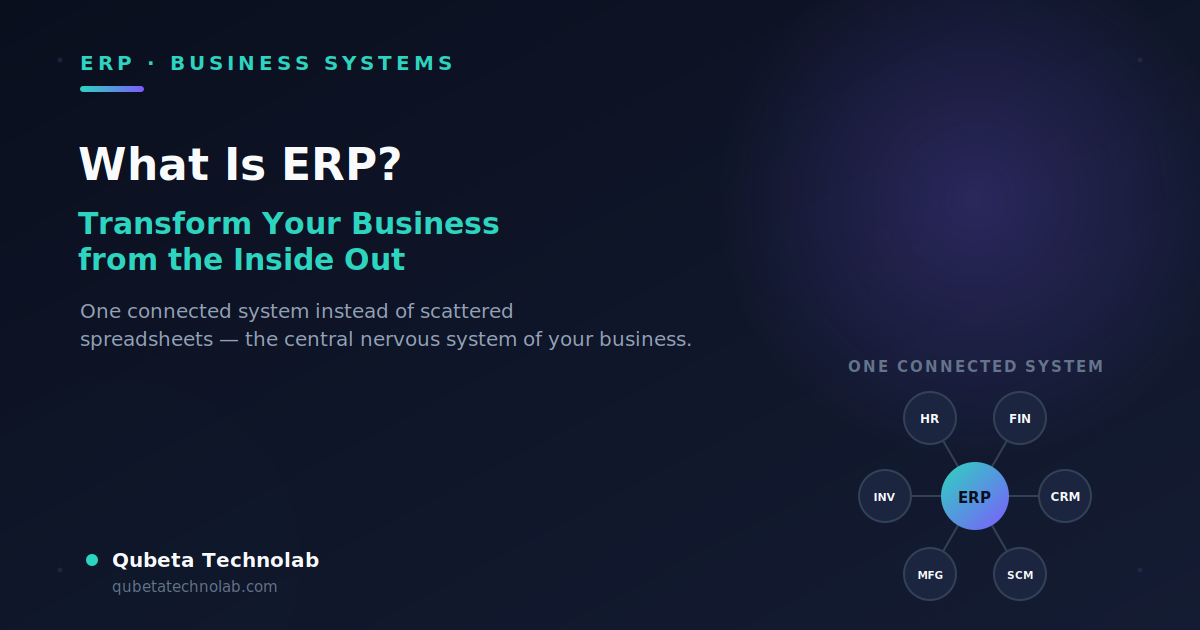
ERP is a type of software that brings all your core business functions into one unified system. Instead of having separate tools for HR, finance, inventory, sales, and operations — an ERP connects them all under one roof, sharing a single database in real time.
Think of it as the central nervous system of your business. When one department does something — say, a sale is confirmed — every other department that needs to know about it (inventory, billing, delivery) gets updated instantly, automatically.
"ERP doesn't just automate your work — it connects your entire business so that everyone is working from the same truth."
The Key Modules Inside an ERP
A modern ERP system is made up of modules, each handling a specific business area. You can start with what you need and add more as you grow.
- Finance & Accounting - Invoicing, expenses, tax, and real-time financial reports
- Human Resources - Payroll, attendance, recruitment, and employee records
- Inventory - Stock levels, procurement, warehouse, and supply chain
- Sales & CRM - Leads, orders, customer history, and sales pipeline
- Manufacturing - Production planning, quality control, and work orders
- Supply Chain - Vendor management, logistics, and delivery tracking
How ERP Transforms Your Business — In Real Life
1. No more data silos
Before ERP, your sales team might confirm a big order — only for the warehouse to discover there's no stock available. With ERP, inventory is updated the moment a sale is made. Everyone sees the same data, at the same time.
2. You make decisions faster — and smarter
ERP gives you dashboards and reports at the click of a button. Instead of waiting days for your accounts team to compile last month's figures, you can see your revenue, expenses, and profit margins right now — live, accurate, and visual.
3. Manual work drops dramatically
Repetitive tasks like generating invoices, sending payment reminders, updating stock levels, or processing payroll — ERP automates all of it. Your team spends less time on admin and more time on work that actually grows the business.
4. Customers get a better experience
When your sales, support, and delivery teams are all working from the same customer data, things don't fall through the cracks. Orders get fulfilled faster, queries get answered quicker, and customers notice the difference.
5. You scale without chaos
Growing a business without ERP means growing your admin headaches too. ERP is built to scale with you — whether you're adding new products, opening new offices, or expanding to new markets, the system handles the complexity so you don't have to.
"The companies that implement ERP early don't just save time — they build a competitive advantage that's very hard for others to catch up to."
Benefits at a Glance
- All your business data in one place — no more scattered spreadsheets
- Real-time visibility across sales, finance, HR, and operations
- Automated workflows that reduce human error and save hours
- Better customer service through unified data
- Smarter, faster decisions backed by live data
- Scales easily as your business grows
- Regulatory compliance made simpler with audit trails
Is ERP Only for Big Companies?
This is one of the biggest myths around ERP. A decade ago, maybe. Today — absolutely not. Cloud-based ERP systems have made it accessible and affordable for startups, small businesses, and growing SMEs.
In fact, small businesses often see the biggest impact from ERP adoption because they're replacing manual processes that were slowing them down the most.
When Should You Start Thinking About ERP?
Sign 1
You're spending too much time pulling data from different places to get a full picture of your business
Sign 2
Mistakes are happening because different teams are working from different versions of the same information
Sign 3
You're growing but your processes aren't keeping up — things are falling through the cracks
Sign 4
You're hiring more people just to manage admin work that a system should be doing
Sign 5
Customers are complaining about delays, wrong orders, or slow support — and you can't easily trace what went wrong
If even two of these sound familiar, it's time to seriously consider ERP.
Final Thoughts
ERP is not just software — it's a transformation in how your business operates. It replaces chaos with clarity, manual work with automation, and gut-feel decisions with data-driven ones.
The businesses thriving today aren't necessarily the ones with the biggest budgets — they're the ones with the smartest systems. ERP is one of the most powerful investments you can make to set your business up for long-term, sustainable growth.
And the best time to start? Before you desperately need it.
Thinking about ERP for your business?
Qubeta Technolab helps businesses in Ahmedabad and across India build custom ERP solutions tailored to their exact needs. Let's talk.
Talk to our team ↗
Explore More
Request A Call Back
Ever find yourself stuck trying to articulate your IT needs or find the right tech solutions for your business? We're here to simplify the process. Let our experts guide you toward innovative, tailored IT solutions that drive success.
