




One Platform, Total Business Control: How CRM, ERP & HRMS Drive Business Growth
-
By Qubeta Technolab
- Aug 04, 2026

Read our latest insights on One Platform, Total Business Control: How CRM, ERP & HRMS Drive Business Growth from Qubeta Technolab covering technology, software development, digital marketing and business growth.
There's a moment almost every growing business reaches. It doesn't announce itself with a single crisis — it shows up quietly, in small frustrations that pile up over time. A sales manager promises a delivery date without knowing if operations can actually hit it. Finance closes the books a week late because half the numbers are sitting in someone's inbox. HR spends an entire afternoon compiling a headcount report that should have taken five minutes. None of these problems are dramatic on their own. But together, they tell a clear story: the business has outgrown its tools.
This is the point where most companies are running five, six, sometimes ten different systems just to keep the lights on — a CRM for sales, a separate tool for invoicing, another for inventory, a spreadsheet for HR, and a messaging app holding it all together through sheer willpower. It works, technically. But it doesn't scale, and it definitely doesn't help you grow with confidence.
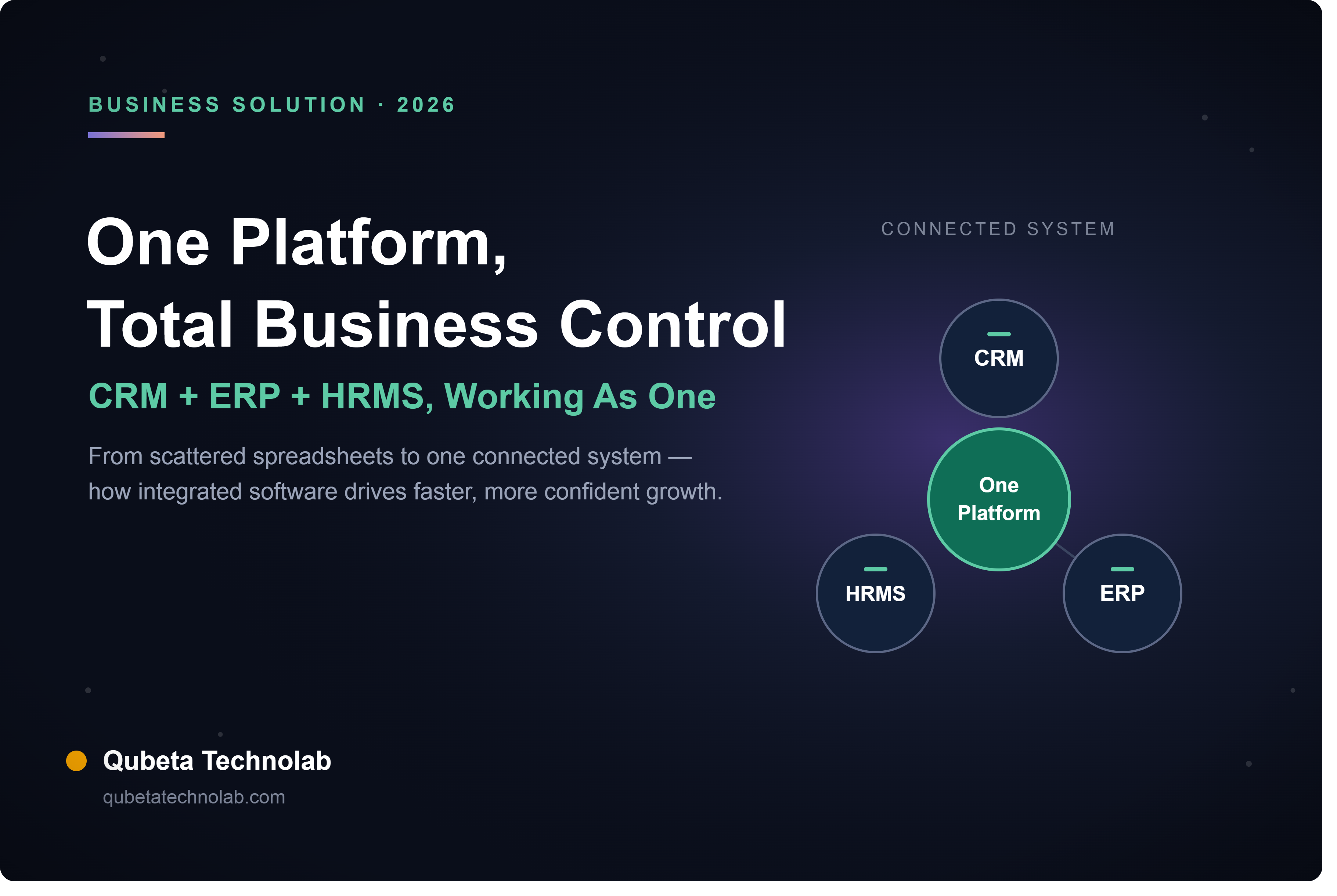
At Qubeta Techno Lab, we approach custom software around a simple belief: a business shouldn't have to choose between growing and staying organized. It should be able to do both, from one place. That's the idea behind bringing CRM, ERP, and HRMS together into a single, connected system — One Platform, Total Business Control.
The Hidden Cost of Disconnected Systems
It's easy to underestimate how much fragmented software actually costs a business, because the cost rarely shows up as a single line item. It shows up as time lost, opportunities missed, and decisions made on incomplete information.
Consider what happens in a typical week at a mid-sized company running disconnected tools:
- The sales team closes a deal but forgets to notify operations, so fulfillment starts late.
- HR updates an employee's role, but payroll is still running on the old designation.
- A customer calls support with a question, but support has no visibility into their sales history or past interactions.
- Leadership asks for a simple revenue-vs-expenses snapshot, and it takes two days to pull together because the data lives in three unconnected systems.
None of these are catastrophic failures. They're just friction. But friction compounds. Multiply these small breakdowns across every department, every week, every month, and you get a business that's spending more energy managing its own tools than managing its actual growth.
There's also a harder cost to quantify: missed opportunities. When leadership doesn't have real-time visibility into sales pipelines, project timelines, and workforce capacity all at once, decisions get made reactively instead of strategically. By the time a problem shows up in a report, it's often already too late to act on it cheaply.
Why "All-in-One" Isn't Just a Buzzword
Software vendors throw around the term "all-in-one" a lot, and it's fair to be skeptical of it. But there's a real, practical difference between a platform that simply bundles separate tools under one login, and a platform that's actually built as one connected system from the ground up.
The difference comes down to data. In a truly integrated platform, a change made in one module automatically reflects everywhere it matters. When a deal closes in CRM, it doesn't need to be manually re-entered into ERP for invoicing. When HR updates an employee's department, that change flows automatically into performance tracking and payroll. There's no duplicate data entry, no version mismatches, no "wait, which system has the correct number?"
This is the foundation we design toward when we build CRM, ERP, and HRMS systems for our clients — not three tools stitched together, but one system working from the same underlying data.
The Three Pillars of Total Business Control
🤝 CRM — Manage Customers
Customer relationships are the lifeblood of any business, and they deserve better than scattered spreadsheets and half-updated contact lists. A well-built CRM gives sales and support teams a single, complete view of every customer — every conversation, every deal stage, every follow-up, in one pipeline.
This matters more than it might seem at first glance. When a salesperson can see a prospect's entire history before a call — past interactions, previous quotes, open questions — they walk into that conversation prepared instead of guessing. When support can see a customer's purchase and communication history instantly, resolution times drop and customer satisfaction goes up. A connected CRM doesn't just organize data; it changes how confidently your team can act on it.
⚙️ ERP — Streamline Business
If CRM is about the customer-facing side of the business, ERP is about everything that happens behind the scenes to make good on what was promised. Finances, inventory, procurement, and project tracking all live in one place, giving leadership a real-time, accurate view of how the business is actually running — not a version that's a week old by the time someone finishes compiling it manually.
This is where a lot of businesses feel the most pain from disconnected tools. Inventory counts that don't match what's actually on the shelf. Project budgets that are only discovered to be over-spent after the fact. Financial reports that require someone to manually reconcile three spreadsheets before anyone can trust the numbers. An integrated ERP removes that guesswork, replacing it with numbers everyone can rely on, updated as the business moves.
👥 HRMS — Empower Your Team
A business is only as strong as the people running it, and yet HR is often the most under-tooled function in a growing company. A connected HRMS brings attendance, leave management, payroll, and performance tracking into one simple, transparent system.
The impact here goes beyond administrative convenience. When employees can see their leave balance, payroll details, and performance feedback clearly and without having to chase someone down, it builds trust. When HR isn't buried in manual paperwork, they have more time to focus on what actually matters — culture, retention, and helping people grow. A smoother HR experience isn't a nice-to-have; it's a direct contributor to how engaged and productive a team is.
From Scattered Data to Confident Decisions
The real payoff of bringing CRM, ERP, and HRMS together isn't just tidiness — it's speed and confidence in decision-making. Imagine opening a single dashboard each morning and seeing, at a glance: total sales and how they're trending, how many projects are active and their current status, headcount and attendance across the team, and a clear read on where the month is heading financially.
That's not a hypothetical. That's what a genuinely integrated platform delivers — one screen, real numbers, no waiting on someone to compile a report. When leadership has this kind of visibility, they stop reacting to last month's problems and start planning for next month's opportunities. Decisions that used to take a week of back-and-forth between departments can happen in a single meeting, because everyone is looking at the same, accurate data.
How This Actually Drives Business Growth
It's worth being specific about how integration translates into growth, rather than leaving it as an abstract promise.
Faster decisions. When data is real-time and centralized, leadership isn't working off stale information. Decisions get made when they're still useful, not after the window to act has closed.
Lower operational costs. Every hour spent manually reconciling data between systems is an hour not spent on higher-value work. Reducing duplicate tools and manual data entry adds up to real savings over time — not just in software costs, but in people's time.
Stronger customer relationships. When sales, support, and operations all work from the same customer data, response times shrink and service quality goes up. Customers notice when a business feels organized, and they notice even more when it doesn't.
A more engaged, more productive team. Employees who deal with a smooth, transparent HR system spend less energy on friction and more on their actual work. That has a compounding effect on retention and performance over time.
Room to scale without re-platforming. One of the most overlooked benefits of an integrated system is that it grows with you. Instead of bolting on a new disconnected tool every time a new department or process is added, a unified platform simply extends to cover it — no painful data migration, no re-training teams on yet another system.
Better cross-department accountability. When sales, operations, and HR data live in one system, it becomes much harder for things to fall through the cracks between departments. Everyone is working from the same source of truth, which naturally improves coordination.
Who Benefits Most from an Integrated Platform
While any business dealing with customers, operations, and employees can benefit from this kind of integration, it tends to matter most at a specific inflection point — usually somewhere between 20 and 200 employees, when a business has outgrown spreadsheets but isn't yet large enough to justify a team of specialists managing five different enterprise systems.
This is exactly the stage where the cost of fragmentation is highest relative to the size of the business, and where the value of a single, well-integrated platform is felt the fastest. Whether it's a services business trying to keep client delivery and finances aligned, a product company juggling inventory and sales pipelines, or a fast-growing team trying to keep HR processes from becoming chaotic, the underlying need is the same: one place to see and manage the whole business.
Smart Solutions for Smarter Businesses
That line isn't just something we put on a banner — it's the actual principle behind how we build. Every system we design for a client exists to answer one question: does this make it easier for that business to see clearly and act confidently? If it doesn't, it doesn't make it into the build.
Whether you're a small business trying to get organized for the first time, or a growing company that's ready to leave spreadsheets and disconnected tools behind, the goal is the same — give you total control of your business from one place, without adding complexity to get there.
The Bottom Line
Growth exposes weaknesses in how a business runs. The companies that navigate that growth well aren't necessarily the ones with the most tools — they're the ones with the clearest visibility into what's actually happening across sales, operations, and people. That clarity doesn't come from adding more software. It comes from connecting what you already have into one coherent system.
With over 5 years of experience building custom web, software, and CRM solutions for businesses in Ahmedabad and beyond, Qubeta Techno Lab has seen firsthand how disconnected systems slow growth down — and how the right integrated platform reverses that. That's the shift we help businesses make: from managing disconnected pieces to controlling one connected whole.
Frequently Asked Questions
1. What is the difference between CRM, ERP, and HRMS?
CRM (Customer Relationship Management) focuses on managing leads, customers, and sales pipelines. ERP (Enterprise Resource Planning) handles core business operations like finance, inventory, and projects. HRMS (Human Resource Management System) manages employee data, attendance, payroll, and performance. Individually, each solves one part of the puzzle — together, they give you the full picture of your business. We've written more on this in Why Your Business Needs a Custom CRM Instead of Generic Software.
2. Why should a small or mid-sized business use an integrated platform instead of separate tools?
Separate tools mean duplicate data entry, disconnected reporting, and more room for error. An integrated platform like Qubeta Techno Lab's keeps everything on one system, so data stays accurate and decisions can be made faster, without waiting on manual reports. For a deeper breakdown, see our Complete Buyer's Guide to Choosing the Best CRM for Small Business.
3. Is switching from multiple tools to one platform difficult?
Not with the right setup support. Our team handles data migration and onboarding, so businesses can move from scattered spreadsheets and disconnected apps to one platform with minimal disruption. Get in touch through our Contact page to discuss your current setup.
4. Can the platform grow with my business as I add more employees or departments?
Yes. That's one of the core advantages of an integrated system — it's built to scale with you, so you don't need to adopt a new tool every time you add a department, expand your team, or open a new location.
5. Do I need technical expertise to use the CRM, ERP, and HRMS modules?
No. We design these systems for business users, not IT teams. Dashboards and workflows are built to be intuitive, so sales, operations, and HR teams can use them without needing specialized training. Explore our full range of software and web development services for a closer look at what we build.
6. How do I get started with Qubeta Techno Lab?
The easiest way to see if it's the right fit is to book a free demo or consultation. Our team will walk you through what an integrated CRM, ERP, and HRMS setup could look like for your specific business.
Ready to See It in Action?
Your success is our tradition. Let us show you how a connected CRM, ERP, and HRMS system — built around how your business actually works — can change the way you run it.
👉 Book a Free Demo today 🌐 qubetatechnolab.com
Qubeta Techno Lab — Your Success, Our Tradition.
Explore More
Request A Call Back
Ever find yourself stuck trying to articulate your IT needs or find the right tech solutions for your business? We're here to simplify the process. Let our experts guide you toward innovative, tailored IT solutions that drive success.
